
CompletableFuture 异步编排实战
异步编程 · 第 2/3 篇
上一篇:《Callable、Future 与 FutureTask》 · 下一篇:《ThreadLocal 原理与内存泄漏》
开头:Future 够拿结果,不够「编排剧情」
查完用户信息还要调积分、调风控、发通知——任务之间有 then、and、or 关系。用 Future 手写线程 + 回调 + 闭锁,代码很快变成面条。CompletableFuture 把编排做成链式 API,并补齐异常与线程池隔离。
一、应用场景速查
| 关系 | 典型 API |
|---|---|
| 依赖(串行) | thenApply / thenCompose |
| AND 聚合 | thenCombine / thenAcceptBoth / runAfterBoth |
| OR 竞速 | applyToEither / acceptEither / runAfterEither |
| 多路并行 | allOf / anyOf |
Future 局限回顾:仅 get 阻塞、无链式回调、难组合多任务、异常处理弱——CompletableFuture 逐一补齐。
二、创建异步任务
CompletableFuture.runAsync(runnable);                    // 无返回值
CompletableFuture.runAsync(runnable, executor);
CompletableFuture.supplyAsync(supplier);                // 有返回值
CompletableFuture.supplyAsync(supplier, executor);| 区别 | 说明 |
|---|---|
runAsync | 参数为 Runnable,无结果 |
supplyAsync | 参数为 Supplier,有结果;get() 会阻塞 |
未指定 Executor 时使用 ForkJoinPool.commonPool()(并行度 ≈ CPU 核数,可通过 -Djava.util.concurrent.ForkJoinPool.common.parallelism 调整)。
强烈建议:I/O 密集任务勿全部使用公共池——慢 I/O 会占满公共池线程,导致全局饥饿。按业务类型创建独立线程池。
Runnable runnable = () -> System.out.println("执行无返回结果的异步任务");
CompletableFuture.runAsync(runnable);

CompletableFuture<String> future = CompletableFuture.supplyAsync(() -> {
    Thread.sleep(5000);
    return "Hello World";
});
String result = future.get();
三、获取结果
get():受检异常(ExecutionException、InterruptedException),阻塞。join():非受检异常,适合 Stream/链式里传播异常。
四、结果处理:whenComplete / exceptionally
任务正常完成或抛异常时执行 Action:
CompletableFuture<String> future = CompletableFuture.supplyAsync(() -> {
    if (new Random().nextInt(10) % 2 == 0) {
        int i = 12 / 0;
    }
    return "test";
});

future.whenComplete((t, action) -> System.out.println(t + " 执行完成!"));
future.exceptionally(t -> {
    System.out.println("执行失败:" + t.getMessage());
    return "异常xxxx";
}).join();- 不以
Async结尾:Action 与上游同线程执行。 Async后缀:可能在其它线程执行(同池也可能同线程)。- 均返回
CompletableFuture,可继续链式调用。
五、结果转换
thenApply
上一阶段结果作为参数,在同一 CompletableFuture 链上转换类型:
CompletableFuture<Integer> future = CompletableFuture.supplyAsync(() -> {
    int result = 100;
    System.out.println("一阶段:" + result);
    return result;
}).thenApply(number -> {
    int result = number * 3;
    System.out.println("二阶段:" + result);
    return result;
});
System.out.println("最终结果:" + future.get()); // 300
thenCompose
上一阶段结果用于展开新的 CompletableFuture(扁平化嵌套异步):
CompletableFuture<Integer> future = CompletableFuture
    .supplyAsync(() -> {
        int number = new Random().nextInt(30);
        System.out.println("第一阶段:" + number);
        return number;
    })
    .thenCompose(param -> CompletableFuture.supplyAsync(() -> {
        int number = param * 2;
        System.out.println("第二阶段:" + number);
        return number;
    }));
thenApply vs thenCompose
| thenApply | thenCompose | |
|---|---|---|
| 返回 | 同一 CF 上改泛型 | 新的 CompletableFuture |
| 用途 | 同步式映射结果 | 依赖下游异步 Stage |
CompletableFuture<String> future = CompletableFuture.supplyAsync(() -> "Hello");
CompletableFuture<String> result1 = future.thenApply(param -> param + " World");
CompletableFuture<String> result2 = future
    .thenCompose(param -> CompletableFuture.supplyAsync(() -> param + " World"));
// 两者输出均为 "Hello World",但 result2 多一层异步 Stage
六、结果消费(无返回值 Stage)
只对结果执行 Action,不返回新计算值(Consumer 只有输入):
| 系列 | 说明 |
|---|---|
thenAccept | 消费单个结果 |
thenAcceptBoth | 两个 Stage 都完成再 BiConsume |
thenRun | 不关心结果,只跑 Runnable |
CompletableFuture<Void> future = CompletableFuture
    .supplyAsync(() -> {
        int number = new Random().nextInt(10);
        System.out.println("第一阶段:" + number);
        return number;
    }).thenAccept(number -> System.out.println("第二阶段:" + number * 5));
// get() 返回 null
七、结果组合与竞速
thenCombine
两路都完成,BiFunction 合并有返回值:
CompletableFuture<Integer> result = future1.thenCombine(future2, (x, y) -> x + y);applyToEither / acceptEither / runAfterEither
谁先完成用谁:
applyToEither:Function,有返回值acceptEither:Consumer,无返回值runAfterEither:Runnable,不关心结果
runAfterBoth
两路都完成再执行 Runnable,不关心结果。
八、allOf 与 anyOf
CompletableFuture<Object> any = CompletableFuture.anyOf(future1, future2);
System.out.println(any.get()); // 任一完成即返回

CompletableFuture<Void> all = CompletableFuture.allOf(future1, future2);
all.get(); // 等都完成;返回 Void,各任务结果仍从原 future get()
九、案例:最优「烧水泡茶」
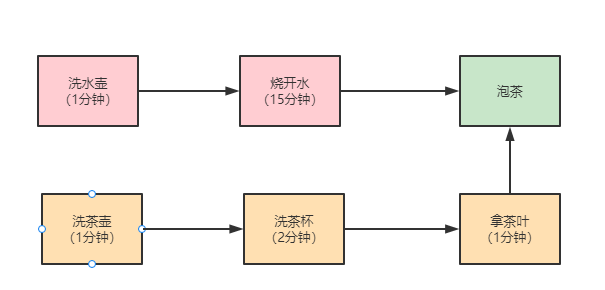
华罗庚《统筹方法》中的经典例子:洗水壶→烧水→泡茶;洗茶壶→洗茶杯→拿茶叶。泡茶前需要茶叶。
Future 版:T2 的 FutureTask 传给 T1,T1 烧水后 ft2.get() 取茶叶再泡。
FutureTask<String> ft2 = new FutureTask<>(new T2Task());
FutureTask<String> ft1 = new FutureTask<>(new T1Task(ft2));
new Thread(ft2).start();
new Thread(ft1).start();
System.out.println(ft1.get());

class T1Task implements Callable<String> {
    FutureTask<String> ft2;
    T1Task(FutureTask<String> ft2) { this.ft2 = ft2; }
    public String call() throws Exception {
        System.out.println("T1:洗水壶..."); TimeUnit.SECONDS.sleep(1);
        System.out.println("T1:烧开水..."); TimeUnit.SECONDS.sleep(15);
        String tf = ft2.get();
        System.out.println("T1:拿到茶叶:" + tf);
        System.out.println("T1:泡茶...");
        return "上茶:" + tf;
    }
}
CompletableFuture 版:声明式组合,代码更短:
CompletableFuture<Void> f1 = CompletableFuture.runAsync(() -> {
    System.out.println("T1:洗水壶..."); sleep(1, SECONDS);
    System.out.println("T1:烧开水..."); sleep(15, SECONDS);
});

CompletableFuture<String> f2 = CompletableFuture.supplyAsync(() -> {
    System.out.println("T2:洗茶壶..."); sleep(1, SECONDS);
    System.out.println("T2:洗茶杯..."); sleep(2, SECONDS);
    System.out.println("T2:拿茶叶..."); sleep(1, SECONDS);
    return "龙井";
});

CompletableFuture<String> f3 = f1.thenCombine(f2, (__, tf) -> {
    System.out.println("T1:拿到茶叶:" + tf);
    System.out.println("T1:泡茶...");
    return "上茶:" + tf;
});

System.out.println(f3.join());
小结
- supply/run Async + 自有线程池 是生产基线。
- 串行用 thenApply/Compose,并行合并用 combine/allOf,竞速用 either/anyOf。
- 异常用 whenComplete + exceptionally;阻塞慎用公共 FJP。
下一篇:ThreadLocal——异步链路上的「线程内上下文」与泄漏陷阱。